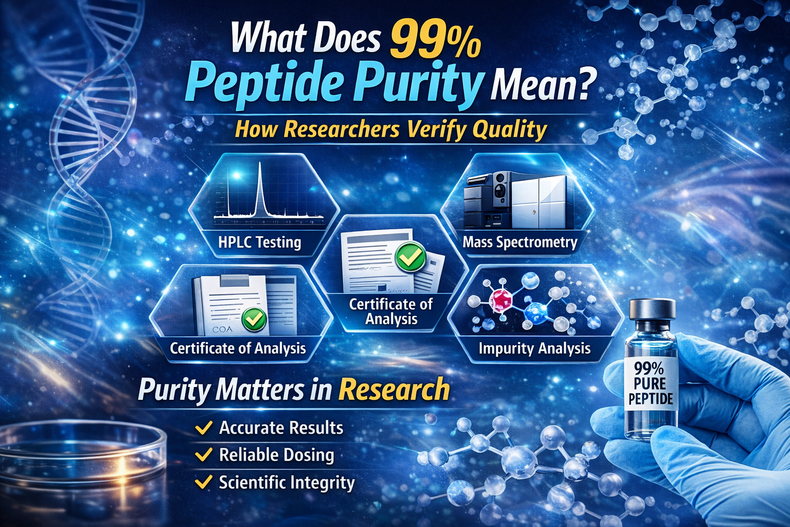
What Is Peptide Pureness And Why Does It Matter In Research-grade Peptides? Qing Li Peptide
Total Checklist Of Confirmed Peptide Suppliers With Certifications Research-grade peptides are made for research laboratory research study usage only-- they are not produced under pharmaceutical GMP standards and are not implied for use as rehabs or in humans. These peptides include a fundamental quality control bundle, typically consisting of HPLC purity evaluation and MS confirmation of identity, ensuring they satisfy scientific standards for purity and composition. They are labeled "for research study use only" to make clear that they are meant for Certificate of Analysis in vitro experiments or pet studies, not for any kind of form of human usage. This is why peptides are commonly offered at different pureness qualities. Carefully connected to truncations, removal peptides are full-length chains that are missing out on one amino acid someplace between. If capping isn't completely efficient, an uncoupled chain can remain to lengthen in succeeding steps, creating a peptide that's just one deposit short of the target. These can be especially problematic due to the fact that their chromatographic behavior is extremely similar to the target peptide, making them tougher to separate throughout filtration.
Where can I send my peptides to examine for pureness?
ACS Peptide Examining Labs is a professional peptide analysis lab that accepts examples from all 50 states. Whether you need to examine peptide purity, validate a provider''s Certificate of Analysis, or run thorough pollutant testing, our lab supplies quickly, exact outcomes with in-depth reporting.
How To Submit Samples For Screening
It separates the target peptide from peptide-related contaminations (deletion series, trimmed fragments, and synthesis by-products). Retention time is the elapsed time from injection to the moment a substance's height maximum is detected. It is characteristic of a compound under specific chromatographic problems (same column, very same slope, exact same temperature level). Constant retention time throughout sets supplies self-confidence that the very same substance is being delivered. If a supplier's lot-to-lot COAs show meaningfully different retention times for the same compound, this suggests either an adjustment in compound or a change in chromatographic conditions-- both of which should have examination.- As the portion of natural solvent progressively increases during the run, molecules are released from the column in order of their hydrophobicity-- the a lot more hydrophobic a peptide, the longer it takes to elute (clean off).
- A compound specified to be 95% pure contains 5% of another thing-- and in a research study setting, that "another thing" issues.
- Purity screening asks just how much of the found example is the main peptide versus related contaminations.
- In concentration-response experiments, these contaminants can change contours, squash plateaus, or introduce biphasic habits that obscures truth task of the target substance.
- Purity ranges widely, from 40% to 80%+ depending on sequence length and trouble.
Pick Your Level Of Screening
Before a peptide is utilized in a research study atmosphere, researchers frequently examine testing paperwork to much better understand item identification, pureness requirements, and general quality standards. With high degrees of experience in carb chemistry and our comprehensive peptide evaluation system, Innovative Peptides can give top notch peptide pureness determination solutions. According to stringent evaluation quality assurance and biosynthetic quality assurance requirements, each peptide is strictly kept an eye on throughout the evaluation cycle. Throughout the discovery, we utilize RP-HPLC combined with MS to establish the molecular weight of the peptide. The absolute quantity of the right peptide in a sample is the item of the peptide material and the peptide pureness. BOC Sciences has a top-tier peptide high quality screening platform, incorporating advanced logical technologies and premium instrumentation to provide exact and efficient peptide top quality assessment services. Research laboratory validation for peptides means utilizing clinical tests to confirm a peptide's identity, purity, and make-up. Top-tier labs frequently report peptide pureness well over 95%, regularly ≥ 98-99%, by utilizing state-of-the-art HPLC and MS analyses. They likewise examine both raw materials and completed peptide vials, which helps catch any kind of pollutants, destruction products, or formulation incongruities. This level of thorough evaluation ensures the peptide's accuracy-- meaning the series and purity are exactly as labeled-- which is essential for speculative reproducibility. By verifying composition with numerous confirmed approaches, laboratory recognition guarantees that scientists get a high-purity peptide that will certainly execute as anticipated in the laboratory. Relied on labs use tried and tested testing procedures to analyze peptide samples and verify their pureness and chemical composition.